
Making the Case for an Impact Report Budget
How do you convince your board or ED that a professional impact report is worth the investment?
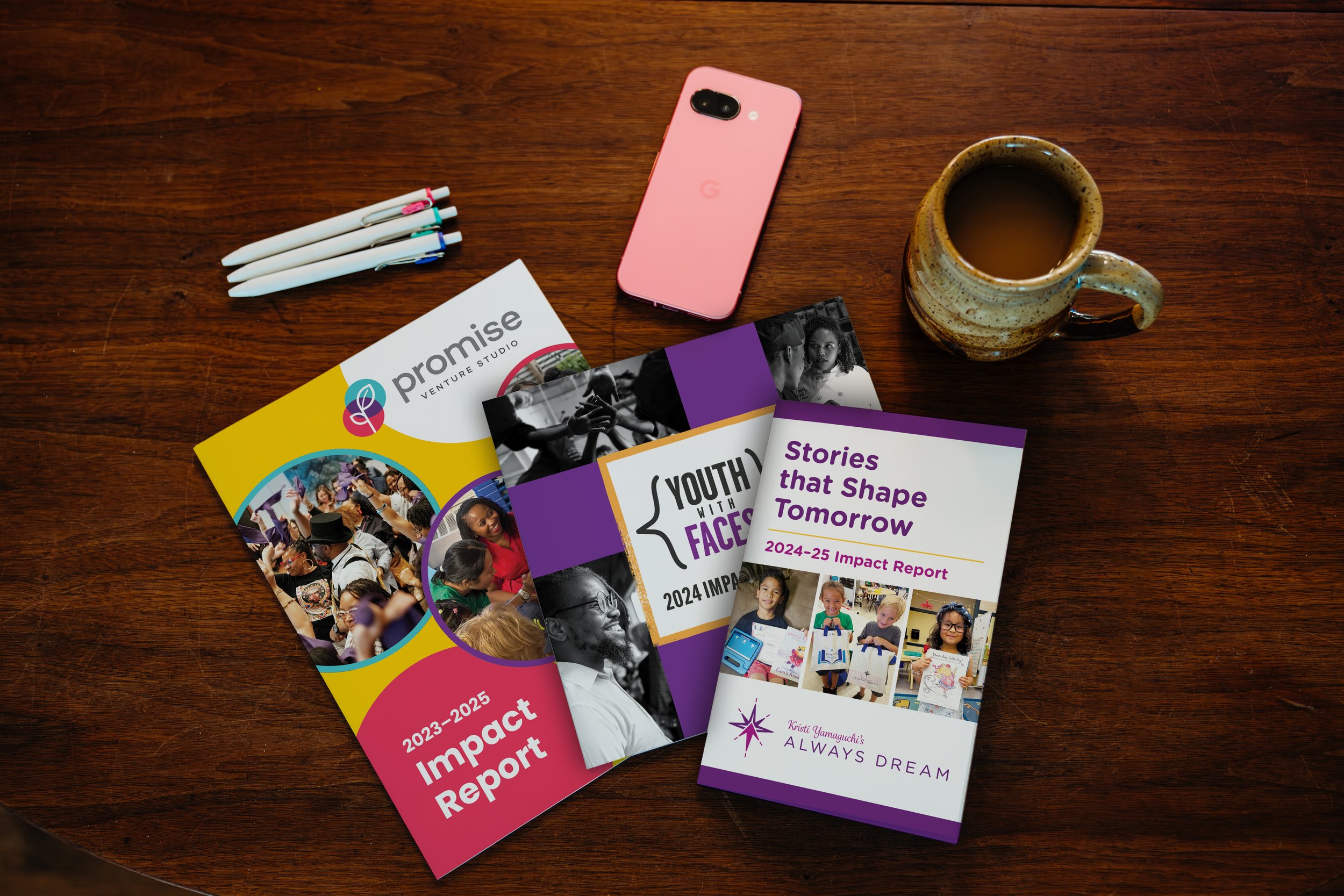
You know you need an impact report. You have stories to tell, numbers to share, and donors, funders, and partners who should know about them.
Then someone asks:
“Can’t we just make it ourselves in Canva?” … or dare I say … “Can’t AI do that?”
Before we even go there, it’s worth asking a different question: what do you need this report to accomplish?
Start with the purpose, not the deliverable
If the conversation starts with “we need a 20-page PDF,” leadership will see it as a production expense. Instead, start with what you want the report to do:
Help donors understand what their support made possible
Give funders a clear picture of your impact
Give your board a shared understanding of the year’s work
Create content you can repurpose all year long
Framed this way, you’re not talking about the cost of a PDF — you’re talking about an investment in how your organization communicates its impact.
Make the value concrete
“It’s important for our brand” won’t win over a finance-minded board treasurer. Instead, think about what the report can support:
Fundraising: stories and stats for appeals, proposals, and donor meetings
Marketing: content for your website, newsletter, and social media
Board engagement: a polished tool to help the board talk about your work
Future communications: a library of approved stories, data, photos, and messaging that your team can use throughout the year
“But we can make it ourselves.”
You can. Canva is a great tool, and there are plenty of situations where a DIY approach makes sense. If you have a relatively simple report, a strong internal designer, plenty of time, and someone who can take ownership of the project from content strategy through final production, you may not need outside design help.
The question is whether that’s the best use of your team’s time—and whether the result will accomplish what you need it to.
A good impact report involves a lot more than putting text and photos into a template. Someone needs to figure out:
What is the story we’re telling?
What information matters to our audience?
What can we cut?
Which numbers deserve emphasis?
How do we make complicated information understandable?
How can stories and data work together?
How do we create a visual hierarchy that guides someone through the report?
How will this work across print, PDF, web, email, and social?
If your communications director, development director, program staff, and executive director are all spending hours collecting information, rewriting copy, formatting pages, fixing charts, reviewing layouts, and trying to make the report work in Canva or … what have you … that’s not free.
It won’t show up as a line item in your budget, but it is still an investment. What else could those people be doing with that time?
So, what should an impact report cost?
A simple report with ready-to-go content, limited data visualization, and a straightforward layout is going to require a very different investment than a highly designed report with custom infographics, extensive editing, original illustrations, multiple rounds of review, etc.
I’ve heard of reports costing anywhere from the low thousands to tens of thousands of dollars. (No shade to the $30K annual report, but that’s not what we’re doing over here.)
As you’re building your budget, think about the level of support you need:
Design: You have the story, copy, data, and images ready to go and mainly need help turning it into a polished document.
Content + Design: Your content is off to a good start, but you need someone to help wrangle it and create the visual system, charts, and graphics.
Strategy + Content + Design: You need help figuring out what the report should say, what to leave out, how to structure the story, and how to bring it all together visually.
The more of the process you outsource, the more you should expect to invest—but you also get more of your team’s time and sanity back.
Give your leadership options
If you’re having trouble getting approval, give leadership a couple of ways to approach the project: DIY, a hybrid approach where your team handles content and a designer handles the design, or full-service support.
This makes the conversation less about “Why does this cost so much?” and more about “Which approach makes the most sense for us?”
The report should do its job
The best reports make it easy for someone new to your organization to understand three things:
What did you do?
What changed because of it?
Why should I care?
If it does that—and gives people a reason to share it, support you, or stay connected—it’s working for your organization.
That’s the argument I’d make when you’re asking for the budget: you’re not asking your board to fund a PDF. You’re asking them to invest in a tool that will help your organization communicate its impact all year long.
FAQs
-
There’s no universal number—costs range from the low thousands to tens of thousands of dollars depending on scope and who your hire. What matters more than the dollar figure is matching your investment to the level of support you actually need: design only, content plus design, or full strategy support.
-
Canva and AI tools can produce a document, but they can’t figure out what story you’re telling, which numbers deserve emphasis, or how to guide a reader through complex information. A designer brings strategy and judgment to those decisions.
-
Any nonprofit that wants its report to do more than document the past year—organizations looking to strengthen fundraising, board engagement, and marketing with one well-built asset, rather than treating the report as a one-off PDF.
-
A report that works harder than a file you print once and forget. Done well, it becomes a source of content for appeals, newsletters, social media, and board conversations—and it frees up your internal team’s time for other priorities
-
Framing the decision as DIY vs. hybrid vs. full-service shifts the conversation from “why does this cost so much?” to “which approach fits us?”—it’s easier for a board or ED to engage with a choice than to approve or reject a single price tag.